

Record Diesel Prices Are Impacting Your Bottom Line. You Can Reduce Costs.
VERIDAPT | September 2026
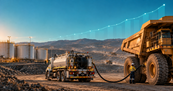
Diesel prices are impacting every litre of fuel a mine purchases. Six questions operations and finance leaders should ask now to manage costs.
Diesel has reached a record high. The U.S. Energy Information Administration (EIA) reported an average on-highway retail diesel price of $6.53 per gallon ($1.72 per litre) for the week of September 21, 2026, the highest nominal level since EIA's weekly series began in 1994. In the first week of January, the same benchmark was $3.48 per gallon. That is an increase of nearly 90% in under nine months.
Mine operators everywhere are feeling the pressure. These are retail prices, not what a mine pays, but every operation is feeling the pressure of record diesel.

Your variances didn't grow. Their cost did.
A mine consuming 100 million litres of diesel a year with a 1% unexplained difference between fuel purchased and fuel recorded as consumed has a one million litre variance. For a mine that burned no extra fuel, the variance cost alone has increased by over $800,000.
In our work with mines around the world, we see mines dealing with variances of 5% or more. A 100ML site at 5% has 5 million litres of fuel it can't fully account for. At even $0.50 per litre, well below this year's increase of about $0.80, that's $2.5 million in added variance cost. Every mine should review their annual variances and rerun this math with their own delivered price.
Whether high diesel prices remain for another year or several years, understanding and controlling your variances is an opportunity to improve your operating margins.
Not every discrepancy is theft
When a fuel number doesn't reconcile, theft is often the first explanation offered. It is a real risk, particularly at large and remote sites. It is rarely the only one.
Discrepancies between purchased and consumed fuel can come from:
- Supplier deliveries that don't match the volume invoiced
- Meter drift or calibration error
- Tank gauging and dip reading errors
- Leaks at tanks, lines or dispensing points
- Tank-to-tank and service truck transfers that aren't recorded
- Fuel allocated to the wrong asset or cost centre
- Equipment configuration problems
- Manual data entry
- Unauthorised dispensing
Each one needs a different fix. Tightening security does nothing about a drifting meter. Recalibrating meters does nothing about an unrecorded transfer.
The first job is finding out which problem you actually have.
Where the variance hides
Fuel changes hands many times on a mine site. It is delivered, stored, transferred between tanks, loaded into service trucks and dispensed into haul trucks, dozers and light vehicles. Every handoff is a place where the recorded number and the physical number can drift apart.
When those handoffs are tracked with spreadsheets, manual tank readings and systems that don't talk to each other, discrepancies tend to show up at month-end, if they show up at all. By then, the transaction behind the gap is weeks old and hard to reconstruct. The site knows the number is off but can't say where or why.
One large mining operation illustrates the point. It consumed more than 100 million litres of fuel a year and its reconciliation was out by more than 10%. It already had remote tank monitoring, but tank levels alone couldn't show where fuel went after delivery. The site metered and recorded fuel across its delivery points, storage, dispensing points and 14 service trucks, and fed that data into its existing site dashboard. The work took around seven months. Reconciliation across the full chain, from delivery truck to consuming asset, came in under 1%.
That result shouldn't be read as a dollar saving. A reconciliation gap can have several causes, and some of the difference is measurement error rather than lost fuel. What it shows is the value of transaction-level data across the whole fuel chain. A percentage tells management a problem exists. Transaction data shows where it sits.
Higher prices raise the value of every fuel lever
Reconciliation is the most visible issue, but it isn't the only one that scales with price. Any saving measured in litres is now worth more in dollars. That includes:
- Spotting haul trucks burning fuel above their normal rate
- Cutting refuelling time and unnecessary fuel stops
- Improving service truck routing and productivity
- Positioning on-site storage to reduce travel and handling
- Capturing every eligible litre in fuel tax credit claims, in jurisdictions that offer them
A business case built last year at last year's diesel price understates the return on every one of these. Finance teams that shelved a fuel control project on the numbers may want to run them again.
Six Questions Mining Executives Should Ask Now
- Can we independently verify supplier deliveries?
Does the volume received match the volume invoiced?
- How closely do physical and book inventory reconcile?
When they don't, can we explain why?
- Can we trace fuel from delivery to the consuming asset?
Including storage, transfers, service trucks and dispensing.
- How quickly do we see an unexplained discrepancy?
A gap found the same day is far easier to investigate than one found at month-end.
- Can we attribute consumption to specific equipment and authorised users?
This gives context when consumption changes unexpectedly.
- Does leadership have one trusted view of fuel across all sites?
Consistent data makes it possible to compare sites and spot exceptions.
Three numbers worth knowing
Higher diesel prices don't create reconciliation problems. They make existing ones more expensive, and they make fixing them easier to justify.
Every operation should know three numbers: annual fuel consumption, actual delivered price per litre and current unexplained variance. Multiply them together and you have the cost of not knowing. At today's prices, for most large operations, it is a number worth a board-level conversation.
All prices in this article are in $USD unless otherwise stated.

Wayne Arthur
VP Mining
Share this article


Read next

VERIDAPT | September 2026

VERIDAPT | September 2026

VERIDAPT| August 2026